By 2047, India's centenary year of independence, more than 800 million people are projected to live in its cities. That's nearly double today's urban population — and it represents one of the most complex planning challenges any nation has ever faced. Roads, water systems, power grids, housing, transit, green spaces: every layer of urban infrastructure must be conceived, designed, and delivered at a scale and speed that traditional planning methods simply cannot support.
This is precisely why India's most forward-thinking city planners, developers, and government bodies are turning to digital twins — virtual replicas of physical urban environments that allow cities to be built, tested, and optimised before a single brick is laid.
The Scale of India's Urban Challenge
India's urbanisation story is unlike any other. Cities like Pune, Bengaluru, Hyderabad, and Chennai are growing not just in population but in economic complexity. Bengaluru alone adds hundreds of thousands of new residents each year, straining infrastructure that was designed for a fraction of its current load. Traffic congestion costs the city an estimated ₹3,700 crore annually in lost productivity. Chennai faces recurring flooding that disrupts millions. Hyderabad is expanding its metropolitan footprint at a pace that challenges even the most agile planning departments.
In 2015, the Government of India launched the Smart Cities Mission — an ambitious programme to develop 100 cities with sustainable infrastructure, data-driven governance, and citizen-centric services. The mission has catalysed significant investment in IoT sensors, integrated command centres, and digital infrastructure. But the connective tissue that makes all of this data actionable — the platform that turns sensor feeds into planning intelligence — is the digital twin.
What a City-Scale Digital Twin Looks Like
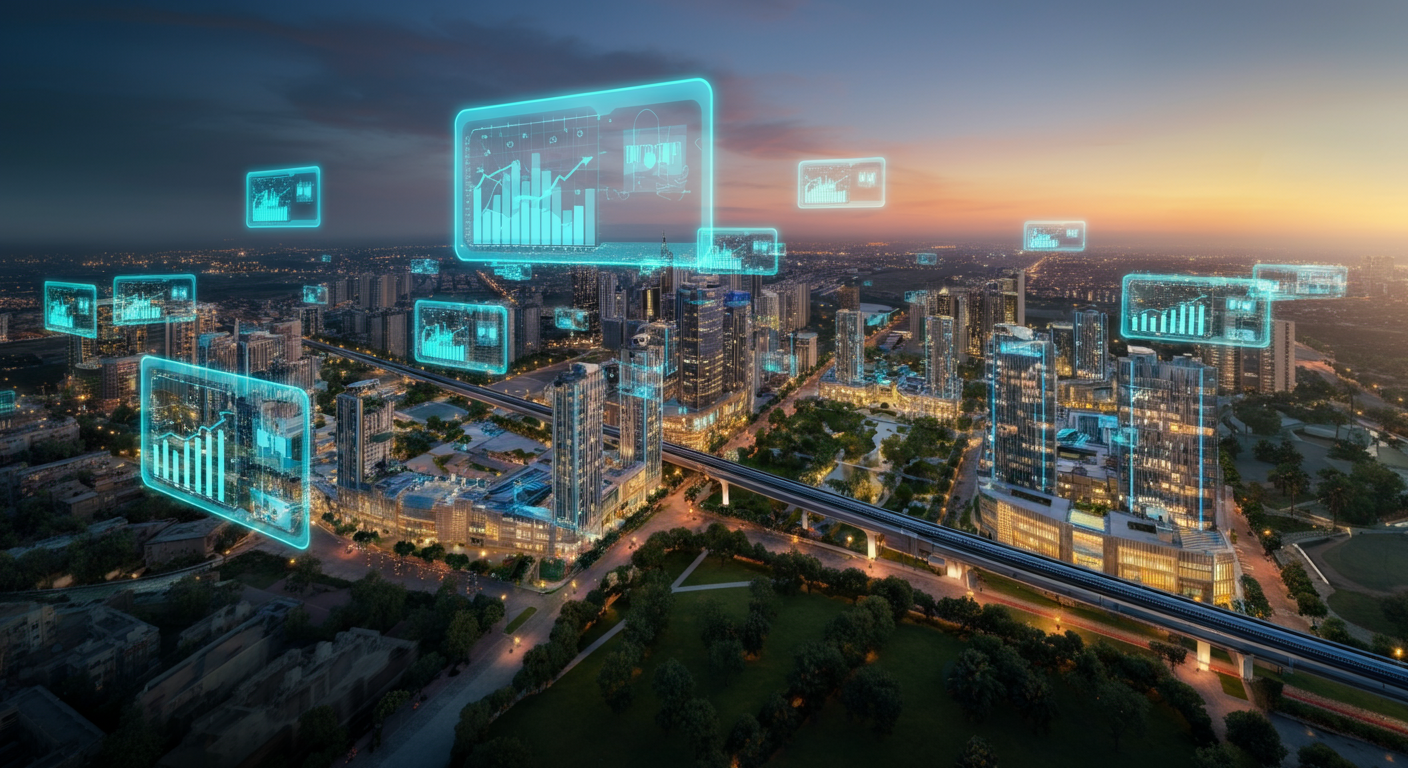
A city-scale digital twin is far more than a 3D map. It is a living, dynamic model that integrates spatial geometry, real-time sensor data, historical records, and predictive analytics into a single, queryable environment. Think of it as a parallel city — one that exists in software, mirrors the physical world, and responds to the same forces: traffic, weather, population growth, energy demand, and environmental stress.
At its core, a city-scale digital twin typically comprises several integrated layers:
- Geospatial foundation: High-resolution terrain models, building footprints, road networks, and utility corridors derived from satellite imagery, LiDAR surveys, and GIS databases.
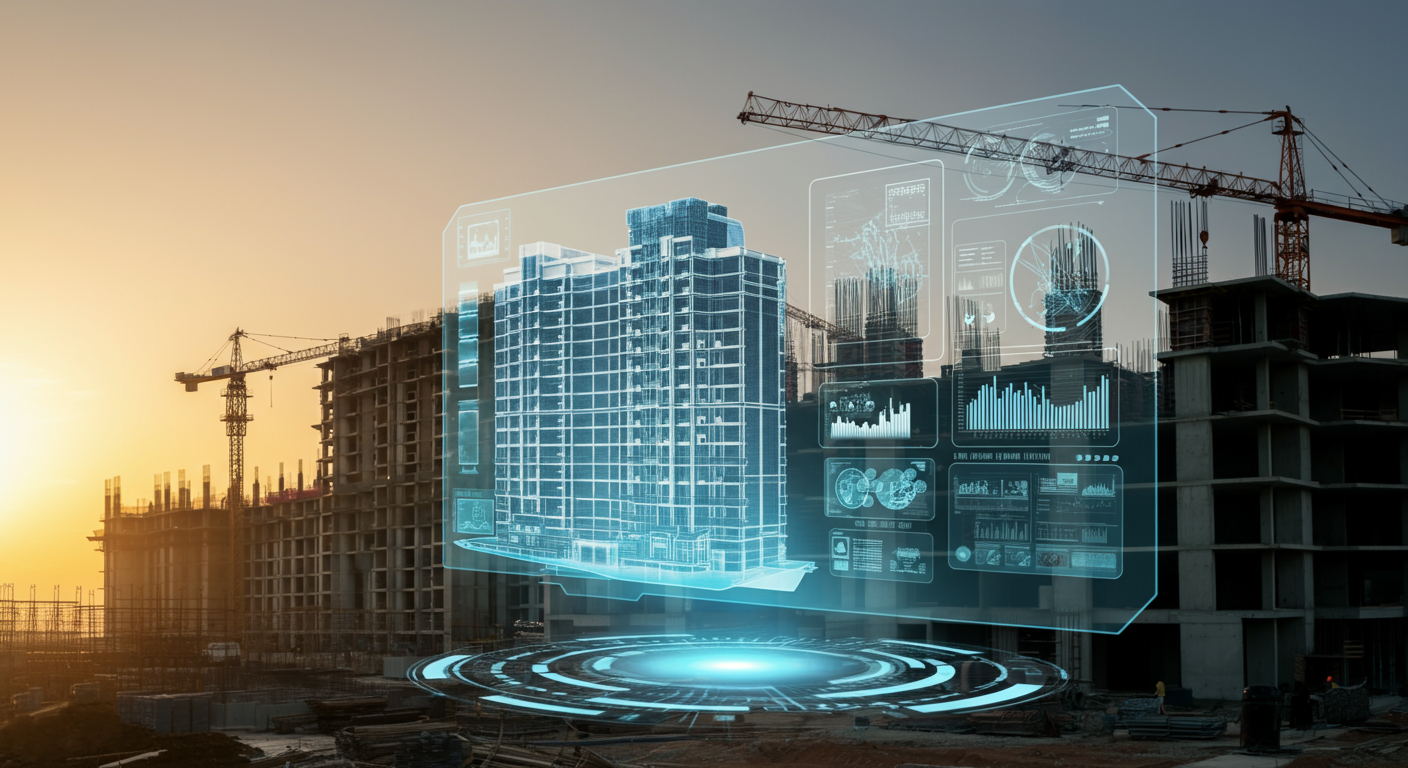
- BIM integration: Detailed building information models for individual structures, linked to the broader urban fabric so that a change in one building's energy profile ripples through the city's demand model.
- IoT data streams: Live feeds from traffic sensors, air quality monitors, water flow meters, and smart grid nodes that keep the twin synchronised with physical reality.
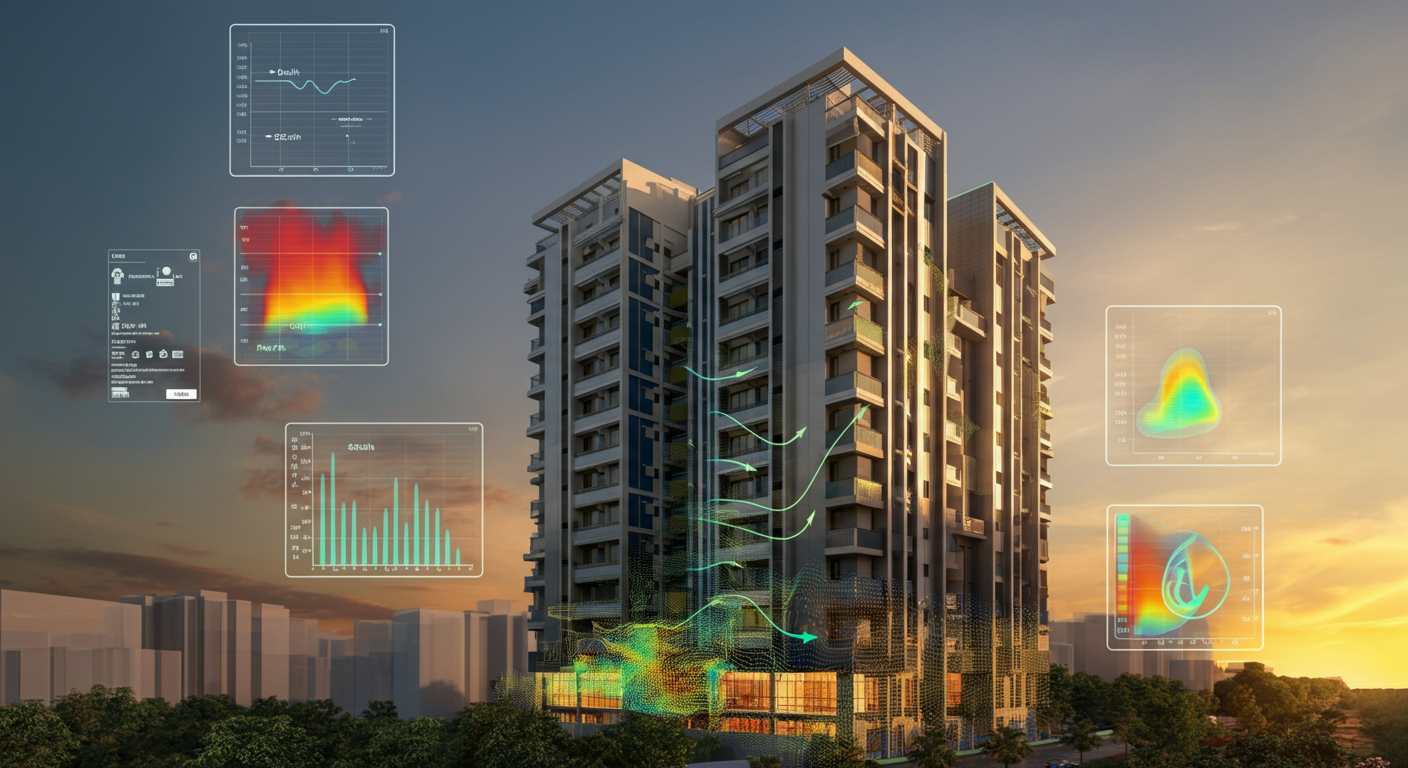
- Simulation engines: Physics-based models for fluid dynamics (flooding, drainage), thermal performance, structural load, and mobility that allow planners to run 'what-if' scenarios before committing to design decisions.
- Analytics and dashboards: Visualisation interfaces that translate complex multi-dimensional data into actionable insights for engineers, planners, and elected officials alike.
The result is a platform where a city can be interrogated, stress-tested, and redesigned — virtually, rapidly, and at a fraction of the cost of physical trial and error.
How Digital Twins Support the Smart Cities Mission
India's Smart Cities Mission has generated an enormous volume of data — from integrated command and control centres (ICCCs) in cities like Pune and Surat to smart traffic management systems in Bengaluru and Hyderabad. But data alone does not make a city smart. Intelligence emerges when data is contextualised within a spatial model that reflects how the city actually works.
Digital twins provide exactly this contextualisation. When Pune's ICCC detects a spike in water consumption in a particular ward, a digital twin can immediately overlay that signal against the ward's pipe network model, population density, and historical demand patterns — identifying whether the spike indicates a leak, a festival, or a data anomaly. What would previously require days of field investigation can be resolved in minutes.
In Hyderabad, the metropolitan development authority has been exploring digital twin frameworks to manage the city's rapid peripheral expansion. By modelling proposed new townships within the city's digital twin, planners can assess the downstream impact on trunk infrastructure — roads, sewage, power — before approvals are granted. This shifts urban governance from reactive to genuinely anticipatory.
Infrastructure Planning and Simulation
Perhaps the most transformative application of city-scale digital twins is in infrastructure planning and simulation. Traditional infrastructure planning relies on static models, periodic surveys, and conservative safety margins that often result in either over-engineered (and expensive) solutions or under-designed systems that fail under peak load.
Digital twins enable a fundamentally different approach — one grounded in continuous simulation and iterative optimisation.
Flood and Drainage Modelling
Chennai's vulnerability to cyclonic flooding has made it a compelling case study for digital twin-based drainage simulation. By integrating topographic data, rainfall records, and stormwater network geometry into a hydrodynamic model, engineers can simulate the impact of a 1-in-100-year rainfall event on specific neighbourhoods — and test the effectiveness of proposed interventions such as retention ponds, permeable pavements, or upgraded culverts before any construction begins.
Mobility and Transit Optimisation
Bengaluru's traffic crisis is well-documented. Digital twin platforms are being used to model the city's road network under different demand scenarios — testing the impact of new metro lines, bus rapid transit corridors, or changes to signal timing on overall network performance. Agent-based mobility simulations can model the behaviour of millions of individual commuters, revealing bottlenecks and optimisation opportunities that aggregate traffic models miss entirely.
Energy Grid Planning
As Indian cities integrate rooftop solar, EV charging infrastructure, and smart metering, the complexity of urban energy systems is growing rapidly. Digital twins allow distribution companies and city planners to model the impact of large-scale solar adoption on grid stability, identify transformer upgrade requirements, and optimise the placement of battery storage assets — all within a virtual environment that reflects the city's actual built form.
Sustainability and Environmental Performance
Sustainability is no longer a peripheral concern in Indian urban development — it is a central mandate. The National Mission for Sustainable Habitat, combined with India's commitments under the Paris Agreement and its net-zero target for 2070, means that every major urban project must now account for its environmental footprint across its entire lifecycle.
Digital twins are uniquely positioned to support this mandate. By embedding environmental performance models within the urban twin, planners and developers can:
- Simulate urban heat island effects and test the cooling impact of tree canopy, reflective surfaces, and green roofs at the neighbourhood scale.
- Model embodied carbon across entire districts, comparing the lifecycle emissions of different construction typologies and material choices.
- Optimise green space distribution to maximise biodiversity, stormwater absorption, and resident wellbeing simultaneously.
- Track operational energy and water consumption across the city in real time, identifying inefficiencies and enabling targeted interventions.
In Pune, where the Smart City initiative has invested heavily in environmental monitoring, digital twin integration is enabling the city to move from measuring sustainability to actively managing it — closing the loop between data collection, analysis, and intervention in ways that were previously impossible.
💡Cities that embed sustainability simulation into their digital twin from the outset — rather than retrofitting it later — consistently achieve better environmental outcomes at lower cost. The earlier the model, the greater the design freedom.
From Township to City: SolidTwin's Role
SolidTwin was built on a foundational insight: that the gap between building-level BIM and city-scale urban modelling is where the most valuable planning intelligence lives — and where most platforms fall short. While enterprise GIS tools handle geography and BIM platforms handle buildings, neither was designed to operate at the intersection of both, at the scale and speed that Indian urban development demands.
SolidTwin bridges this gap by providing a unified digital twin environment that scales from individual buildings to entire townships and, increasingly, to city districts. For developers working on large integrated townships in cities like Hyderabad and Pune, SolidTwin enables:
- Master plan validation: Testing whether a proposed township layout meets density, green space, and infrastructure capacity requirements before detailed design begins.
- Infrastructure right-sizing: Simulating peak demand scenarios for water, power, and mobility to ensure that trunk infrastructure is neither over-built nor under-specified.
- Sustainability certification support: Generating the simulation outputs required for IGBC, GRIHA, and LEED certifications directly from the digital twin, eliminating duplicated modelling effort.
- Stakeholder communication: Producing photorealistic visualisations and interactive dashboards that allow investors, government approvers, and future residents to understand and engage with the project.
As Indian cities grow in ambition and complexity, the role of platforms like SolidTwin will only expand. The next frontier is not just modelling individual townships but connecting them — creating federated city-scale twins where the decisions made at the project level are automatically evaluated against the city's broader infrastructure capacity and environmental targets.
India's urban future is being built virtually first. The cities that embrace this shift — that invest in digital twin infrastructure as seriously as they invest in physical infrastructure — will be the ones that manage their growth with intelligence, resilience, and purpose. The rest will be playing catch-up for decades.
ℹ️SolidTwin is actively working with developers and urban bodies across Pune, Bengaluru, Hyderabad, and Chennai to deploy city-scale digital twin solutions. If you're involved in large-scale urban development in India, we'd welcome a conversation.