How Environmental Analysis Improves Building Design in India
The harsh reality that most people in the Indian real estate sector do not like to accept is that a substantial number of buildings are designed with the intention of being completed on paper, and not with the intention of performing well. They satisfy regulations, they obtain approvals, they look great in CGI drawings, and then comes moving in. Apartments become hot by noon. The bedroom gets harsh western sun but lacks cross-ventilation. The air-conditioning electricity bill inches up silently with the passage of months. The common areas look lit or stuffy. The offices run on artificial lighting all day long, even when they are located in the sunny cities. It’s not a mistake. It is the direct effect of buildings lacking a building knowledge study. It is not about malice. It is about generations-old workflows. The Indian buildings still exist and are designed using static drawings, assumptions, and post-design correction measures. The behavior of the environment concerning the flow of heat, air, or light is not even taken into account until the problem becomes tangible, and that’s already too late.
The environment scan alters that process. The performance focus moves from after occupation to before construction. In the Indian climate, such a shift is no longer a choice.
India’s Climate Is Not Forgiving And It Never Was
India does not have multiple climates. This is what makes it so complex. Arid and hot climates, for example, Rajasthan, have drastically different conditions from warm and humid climates like Mumbai. Composite climates, for example, Delhi, show extreme variations. For example, a high rise and a low rise in two different cities, Mumbai and Indore, have conditions drastically different from each other.
Nonetheless, the Indian property sector seems to find a way to come up with designs as if all this doesn’t even matter The same glass façade is repeated in Bengaluru and Gurugram. The same tower orientation is repeated from Pune to Noida. The sizes of the balconies are repeated, ignoring the latitude and solar angle. None of these are design choices they are skipped. And the effects will just come later. Environmental analysis reveals the danger in what amounts to a copy-and-paste process. As the developers model solar radiation, daylight, wind patterns, and solar gain, the assumptions fall apart. A façade that appeared to be upscale has a hot solar load. A community-encouraging space becomes a heat trap. A well-designed tower layout indicates stagnation areas. It isn’t talk of theory, of sustainability, that is happening here. It is a series of simulations which speak clearly to the numbers the developer wants to hear about temperature increase, cooling demand, risk of glare, costs of operation. Environmental analysis does not beautify design, nor does it ornament analysis. It interrogates design. And in the reality of India's varied climate, such interrogation is no longer a matter of choice.
Daylight Analysis: Why “Bright” Is Not the Same as “Livable”
Most Indian projects boast of "ample natural light." Very few check what that really translates to. Daylight analysis reveals something important: too much light can be as problematic as too little. Harsh glare, overheating, and an uneven distribution of illumination simply cause blinds to stay shut and lights to stay on - completely defeating the purpose.
Environmental analysis allows designers to test:
- How deep daylight can penetrate into a living space.
- whether rooms receive usable morning light or punishing afternoon glare
- How floor plates actually behave across seasons, not just in marketing renders
In Indian cities, where the demand for electricity is already high,Daylight optimization is not just about comfort; it's directly related to energy consumption. Well-analyzed daylight strategies reduce dependence on artificial lighting while maintaining thermal comfort. That's a balance that cannot be guessed; it has to be simulated.
Thermal Comfort Is a Financial Issue, Not a Design Preference
Comfort is a matter of style desirable to have, something to be addressed later, or something that the HVAC will just take care of. In truth, when buildings are not thermally comfortable, they represent a latent cost in a quiet manner. In the Indian market environment, where cooling is already the predominant function of buildings consuming more energy, design as a concept has a concrete impact on costs. Environmental thermal analysis makes this apparent from the start. It simulates the infiltration of heat into the structure, the trapping of this heat, and the rate at which the heat is dissipated. This includes orientation, material, glazing ratio, depth of shading, and ventilation strategy, all considered prior to casting the concrete.
Developers are faced by a situation where:
- Reduce HVAC size estimates
The buildings that properly utilize heat require smaller cooling infrastructure. This means lower initial investment costs and helps save space at the plant site. This can be particularly beneficial for high-density projects.
- Lowered long-term operating costs
Energy efficiency in thermal performance immediately affects the electricity bill. In the current market scenario, where consumers scrutinize the maintenance cost associated with the cost of the product, it becomes a market advantage.
- Increased Asset Value & Leasing Attraction
Functional commercial assets, which have predictable performance, are typically more appealing to better tenants, last longer, and encounter less resistance in leasing or selling.
Energy performance is no longer invisible to the average consumer. Owners are asking tougher questions about operating expenses and comfort. Developers who possess the answers to these questions in any form other than assumptions are building superior structures; they are building financially sustainable structures.
Airflow and Ventilation: The Most Ignored Comfort Variable
Cross-ventilation has got to be the most abused promise in Indian real estate and the least checked. It finds its way into marketing literature, hoardings outside projects, and sales presentations and very few projects check it out to see if the airflow actually happens the way it’s supposed to. This is what Environmental Airflow Analysis removes. It reveals in unvarnished language where the airflow occurs on the site, where it speeds up or dies out, and which apartments are literally being smothered for having "well-placed windows." This is important because India doesn’t breathe evenly. Pollution levels vary from block to block and from city to city. There are still large areas where nature-based ventilation is considered the most preferred means for people to cool their houses. The cost is high for air conditioning, there is no steady power supply, and lack of proper airflow means air conditioning becomes essential for survival rather than comfort. Wrong airflow means retention of heat in buildings, HOLDING pollutants in homes, and paying for it each month.
Airflow simulation catches trouble that will never appear in any drawing. Towers too close together form pressure shadows. Corridors are blocking airflow. Windows properly placed on paper will never work as well when actual airflow has been included. It would seem that by simulating these conditions early on, orientation changes, spacing of buildings, corridor shapes, and opening positions are still possible when the project is still flexible. At this point in development, the price of adjustment is effectively free. Good airflow isn’t a marketing term. It has nothing to do with whether a structure truly breathes. And companies that test for it early prevent decades of customer dissatisfaction and energy wastenot to mention companies that must explain how a "cross-ventilated" home can never be clean.
Regulatory Pressure Is Quietly Shifting Toward Performance
The Indian regulatory system is developing, albeit at a slow pace. Green building ratings, environmental impact assessments, as well as government inspections, are getting more stringent especially in metropolitan cities. A growing concern is no longer just what is built but how it performs. Environmental analysis improves approval processes through changes from assumptions to clarity. Rather than arguing over intentions, parties assess results. This eliminates approval hurdles, design iterations, and compliance issues late in development. In big projects, the saved time from approvals equals the amount of money saved.
Environmental Analysis Reduces Risk Before It Becomes Expensive
"One of the least talked about, but most financially impactful, aspects of environmental analysis is risk reduction. In Indian real estate, risk is rarely a result of exciting concepts; it is a result of tacit assumptions." In design, making decisions without hard data is a leap that is based on experience, analogy, and hope. Sometimes it succeeds. Sometimes it fails. Environmental simulation fills this void with information. Rather than settling upon a design direction and hoping it will function well, designers can use these years to investigate a series of what-ifs. Environmental analysis makes design a comparison rather than a guess:
- Orientation options: Various building orientations can be tested against solar exposure, wind patterns, and heat gain. What looks symmetrical on plan may perform wildly differently on site. Simulation shows which orientation reduces cooling loads, glare, and overheatingbefore concrete is poured.
- Shading strategies: Balcony depths, overhangs, fins and screens can be analyzed based on actual performance rather than aesthetic value. For instance, developers can determine how much heat and glare each option blocks, and whether the added construction cost delivers real operational savings.
- Material selection: Façade systems, glazing types, and roofing materials can be compared on the basis of long-term thermal behavior and energy impact, rather than on upfront cost. This prevents value-engineered substitutions that look harmless but quietly inflate operating expenses for decades.
In this way, running these comparisons early allows environmental analysis to move the process of design from being a roll of the dice to an investment decision. What happens from construction through occupancy, when errors are costly and visible, moves to the design phase, where an adjustment is easy and painless. In itself, this process difference is the distinction between a robust project or a fragile one for developers targeting slim-margin, closely watched markets.
From Sustainability Talk to Measurable Advantage
“Sustainability” could be viewed as a brand service mark within the Indian real estate industry. Sustainability as a brand service mark is given a quantifiable edge by environment analysis. Green projects with built-in environmental intelligence:
- Operate more efficiently
Buildings made environmentally intelligent enhance energy, ventilation, and daylight. The systems work in a more optimal manner, the cooling load decreases, and the maintenance cycle becomes a predictable process.
- Financially age better
An efficient building means more than a building that is comfortable to live in. An efficient building is one that retains its value in money. This is because such a building doesn’t need frequent renovations, which means its value depreciates at a slower rate, thus fetching higher returns in the long run.
- Receive fewer complaints from occupants
Environmental design considerations such as orientation, daylighting, air movement, and shading correlate immediately with user comfort. If the users receive consistent thermal comfort, adequate ventilation, and daylight, complaint levels sink immediately, and support services expenditure after completion is reduced.
- Holds Value Better
In a competitive real estate market, the properties sought by builders and investors will be the ones that are desirable even in the distant future. Green buildings are always in vogue and provide better returns compared to properties emphasizing mere aesthetics.
Based on the Indian environment, in which quality supercedes cosmetic differences in the mind of the customer, these four elements of environmental intelligence give a significant competitive advantage that translates sustainability from a selling requirement to a difference-maker.
Why Environmental Analysis Works Best as a Digital Twin
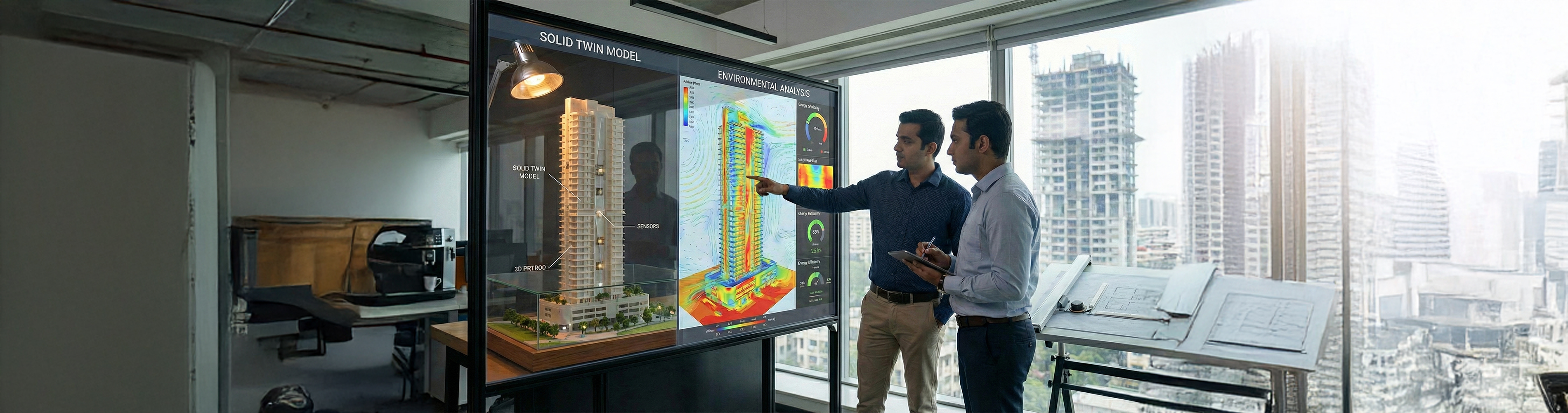
The potential of environmental analysis is realized when integrated in a digital twin, as opposed to being a series of isolated simulations or static reports. A digital twin is where environmental information is used to “build a living, interactive model in which developers, designers, and others can experience performance in a spatially accurate, immersive experience.” This is where light patterns are no longer a graph, where air flows, where heating patterns can be watched in real-time. Use patterns, as in where people move through corridors, where they occupy a room, where they use a shared area, become experiential, no longer just calculations. This enables more intuitive and actionable analysis of technical data. Architects and design professionals will be able to immediately assess intangible impacts of design decisions, design teams will be able to foresee problematic zones before they occur, and sales teams will be better able to communicate these advantages to consumers.. Decisions in every stage of a project are made from a unified basis, which reduces misunderstandings, avoids costly rework, and speeds up approval. Through a digital twin, better understanding of environmental behavior translates to a more predictable, more transparent, and fitting project, in conformity to operating needs as well as market dictates.
The Indian Reality: Build Once, Live With It for Decades
Buildings in India cannot be considered disposables or short-term acquisitions; rather, they act as investment tools for extended periods of time, harboring families, companies, and institutions for generations. Each and every design_choice made presently will have repercussions for the whole lifetime of the edifice. A badly designed tower will remain an energy-absorbing structure for several generations, while an improper air flow design will make it an uncomfortable living space for its inhabitants.
This is recognized by environmental analysis. Environmental analysis is aware that reality is hardly static. The process considers buildings as ever-changing long-term systems instead of discrete projects. Developers are able to make educated guesses that equal performance, comfort, and affordability over many decades by simulating sunlight, wind, temperature, and occupation patterns even prior to construction. This changes the perspective from problem-solving to designing ahead by ensuring that structures work at their best from day one onwards. This is precisely why there is such rapid adoption of environmental analysis as a tool within the Indian property market. This is because property developers are starting to realize that in terms of durability and sustainability, this additional step is not something that has to be considered optionalit has to be considered necessary.
Environmental Analysis Is No Longer Optional in India
In the present-day Indian realty context, it is not a question of being a luxury to beindulged in, a ‘tick the box’ exercise to comply with norms, or even a future-ready lab experiment. The future is a harsh reality check that demands consideration at every stage of construction design and execution, whether it is orientation, materials, glazing proportions, or natural ventilation design. The realty investor not coming to grips with the real world will be courting disaster. The other will be safeguarding against it. Climatic-defying buildings will forever struggle with the elements, resulting in increased operating costs, accelerated deterioration of the building itself, as well as disgruntled tenants. Climatic-compliant buildings will cooperate with the elements for free. The future of building design in India does not permit guesswork. It is for those who stop speculating and start experimenting, who stop designing for standard templates and start modeling for realistic scenarios, who consider each project as a living entity, with quantifiable outcomes. In 2026, it is costly to be hesitant, and it is expensive to be ignorant. It is time to take action, to model, and to design, perform, and risk becoming obsolete in a market place that celebrates nothing but certainty.