Gujarat has become one of the fastest-growing hubs for the real estate and industrial sectors. Cities like Ahmedabad, Surat, Vadodara, and Rajkot are witnessing a slew of developments, especially residential, commercial, and infrastructure projects. However, as a consequence of the rapid urbanization and increasing interest in the region for investment, developers are under tremendous pressure to deliver the project efficiently, precisely, and with the highest possible profit. Conventional planning and development techniques, like 2D designs, images, and project management, are not sufficient enough to handle the complexities of the project.
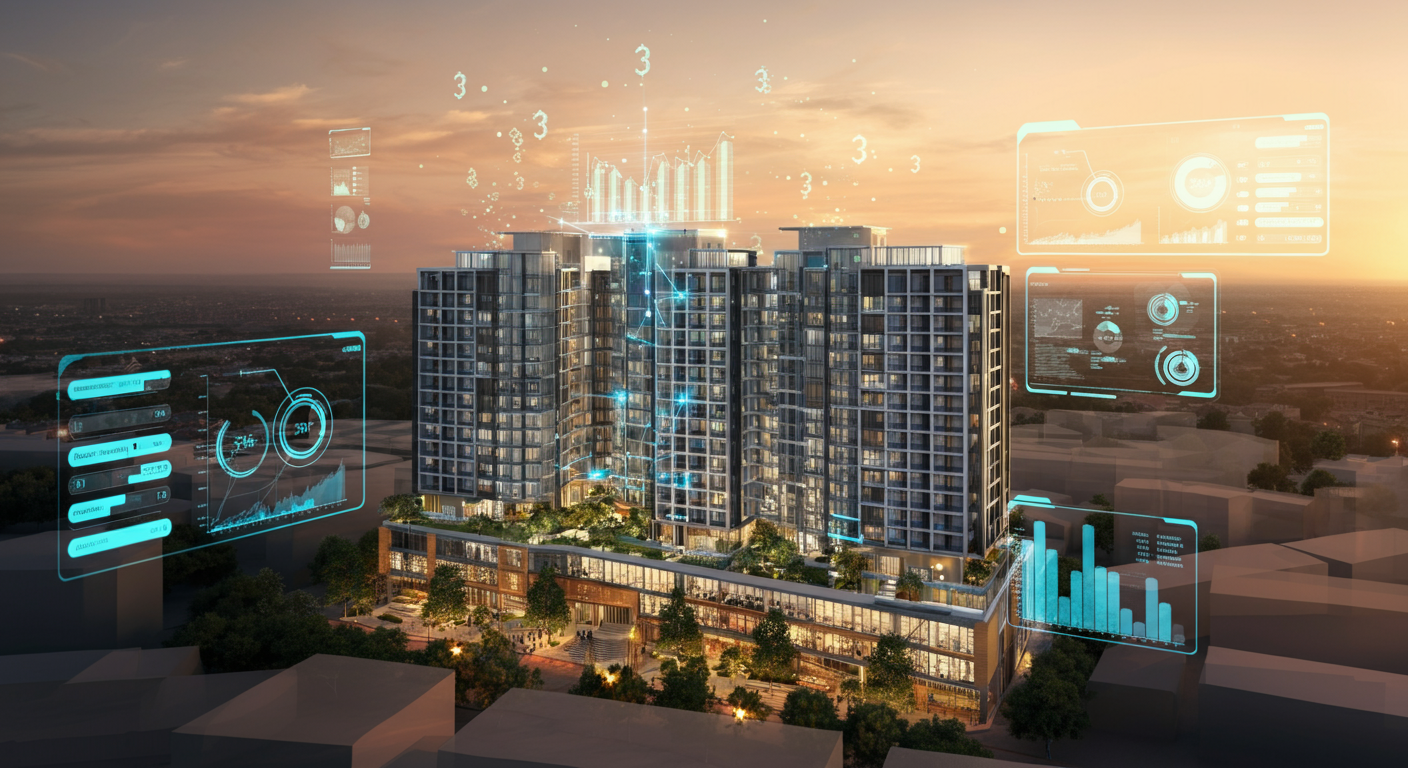
Digital Twin Technology: Digital Twin technology has become a revolutionary tool for developers of the real estate and construction industries. Digital Twin can be defined as a virtual replica of a physical entity or a building, which includes its designs, operating data, and sometimes live data. Digital Twin technology has revolutionized all aspects of the project for Gujarat’s real estate developers.
Understanding Digital Twin Technology
A digital twin is more than just a 3D representation, although it can be one. It is more than just an interactive walk-through, although it can be one too. What makes it different from just a 3D representation is the fact that, whereas the 3D representation is concerned with the visual presentation of the object, the digital twin is concerned with the integration of all the information layers, such as the architectural plans, structural plans, MEP plans, and sometimes even real-time monitoring through IoT technology of the construction process or the building.
The advantage of the digital twin is the fact that it allows the developer to simulate real-world conditions, analyze them, and predict the outcome of his design in a virtual world. It is dynamic, changing with the progress of the construction, changes in the process, and changes in the actual building.
The advantage of the technology for the builder is the fact that it gives him a holistic view of the project.
Driving Factors for Adoption in Gujarat
Several reasons are responsible for the increasing demand for digital twin technology among builders in Gujarat.
- Complexity of Modern Projects
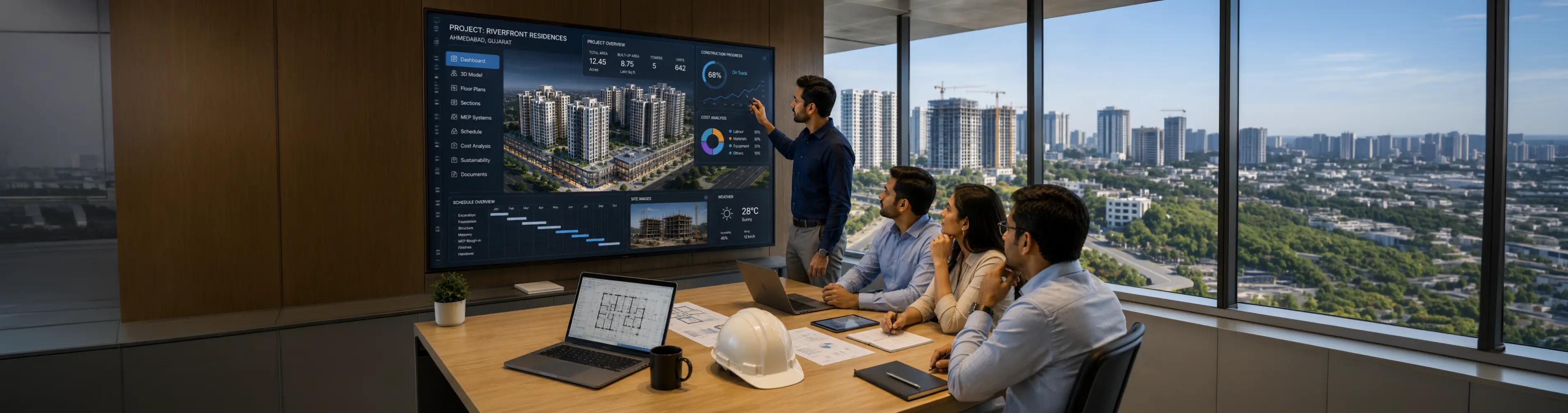
The projects being undertaken by builders in Gujarat are highly complex and involve large-scale mixed-use development with various zones such as residential, commercial, and recreational areas. Managing various facets of such projects is a challenge for builders and developers. Nevertheless, digital twin technology has provided a platform for all stakeholders to come together and join hands on a single platform. It has enabled architects, engineers, and project management teams to assess various interdependencies associated with various zones in the projects and simulate the construction process before execution.
- Demand for Speed and Efficiency
The increasing demand for property in cities such as Ahmedabad and Surat is necessitating developers and builders in Gujarat to ensure that projects are completed as soon as possible. Digital twin technology has been highly beneficial for developers and builders in Gujarat as it enables them to simulate the construction process and ensure that no delays are experienced in the execution of projects. For instance, it can be used for simulating the construction process for a high-rise apartment complex and avoiding conflicts between various structural components such as beams and ducts.
- Investor and Buyer Expectations
Investors and buyers are increasingly requiring transparency and interaction. With digital twins, developers can provide project data in an interactive way, from floor plans to energy efficiency and simulation. This will help to increase trust and speed up approvals, which is particularly important in the competitive real estate market in Gujarat.
The government in Gujarat has regulations that require developers to comply with zoning, environmental, and safety regulations. Digital twins make it easy to comply with regulations by providing code-checking and simulation tools that enable developers to make accurate proposals for approval.
Benefits of Digital Twin Technology
Digital twins offer builders various benefits:
- Improved Planning and Design Accuracy
Digital twins give builders a chance to see all aspects of the building in a detailed environment. This allows builders to simulate all aspects of the building, including architectural, structural, and MEP aspects, which helps ensure that the final construction of the building matches the design plan. This helps builders avoid mistakes and ensure the quality of the building, while at the same time saving money on costly changes.
- Real-Time Monitoring and Construction Management
Digital twins can be integrated with sensors that give real-time information, which allows builders to monitor the construction process. This allows managers to see the construction process and milestones, including any problems with quality and compliance, regardless of their location relative to the construction site.
- Risk Reduction and Predictive Analysis
Digital twins assist construction developers in simulating a construction environment, identifying bottlenecks, and predicting potential issues. For example, construction developers can utilize digital twins to simulate the effect of weather on a construction schedule or simulate the stress of a building structure. In this way, construction developers can address issues in advance to avoid problems and reduce costs.
- Marketing and Stakeholder Engagement
Digital twins offer immersive experiences for investors, buyers, and tenants. Not only can they see the construction, but they can also interact with the construction, walk through the construction, and experience the functionality of energy-efficient lighting, furniture arrangement, or common area usage. This will boost stakeholder engagement and confidence, resulting in pre-sales and investments.
- Integration with Smart Building and Sustainability Initiatives
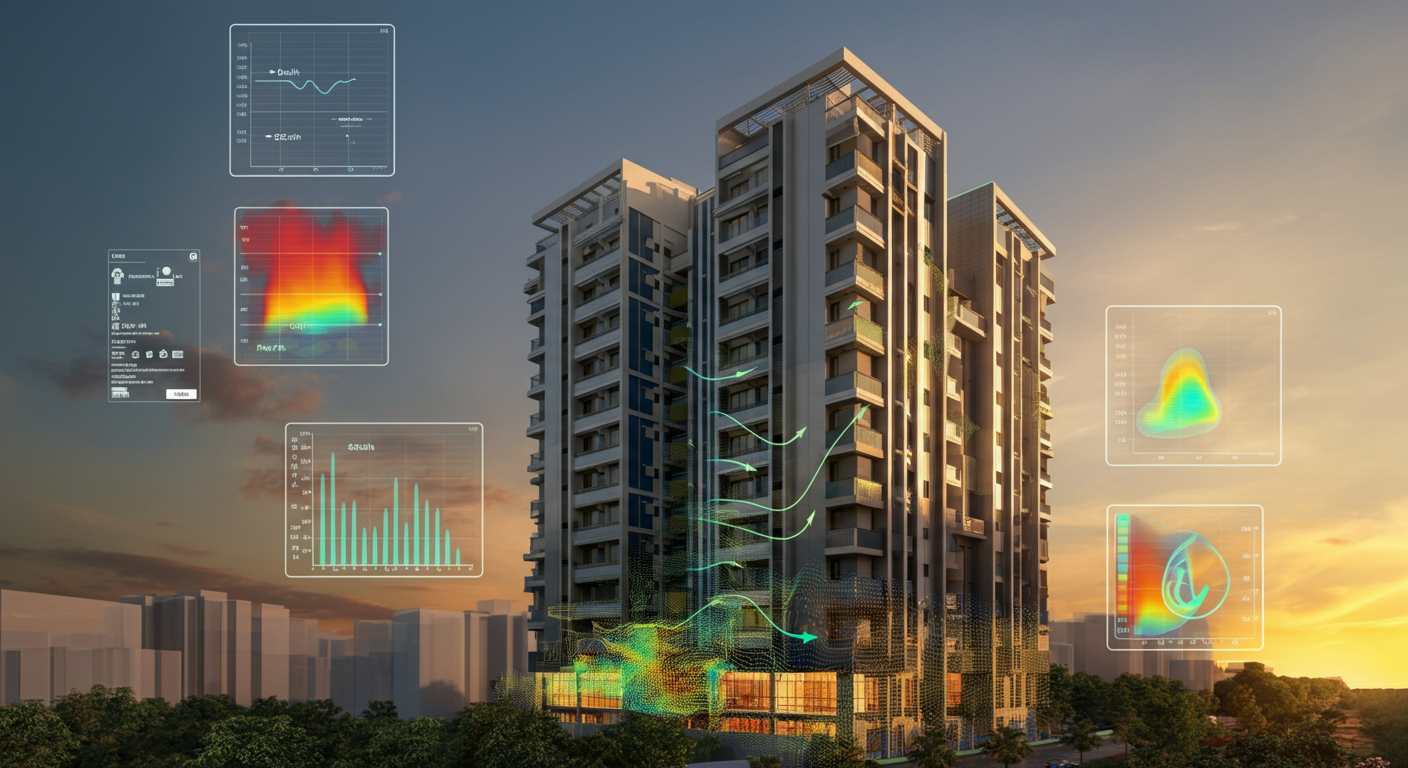
Gujarat is slowly embracing sustainable urban development. Digital twins assist construction developers in simulating energy efficiency, water efficiency, and material efficiency, which assists in green building certification and sustainable initiatives. For construction developers who are planning energy-efficient residential or commercial projects, digital twins assist them in gaining insights into design optimization and efficiency.
Real-World Applications in Gujarat
Upscale and mid-range residential projects are one area where the implementation of digital twins is highly advantageous. For instance, in Ahmedabad, developers are working on creating virtual versions of residential apartment complexes, where potential buyers can virtually move through the interior spaces of the buildings, examine the materials used, and even test the environments.
Commercial spaces such as offices, shopping malls, and business centers use digital twins for analyzing space and operational dynamics. Buyers and investors can virtually examine space and accessibility, and even business management strategies, all within the virtual world. This eliminates the need for physical visits and aids in faster decision-making.
- Mixed Use and Infrastructure Projects
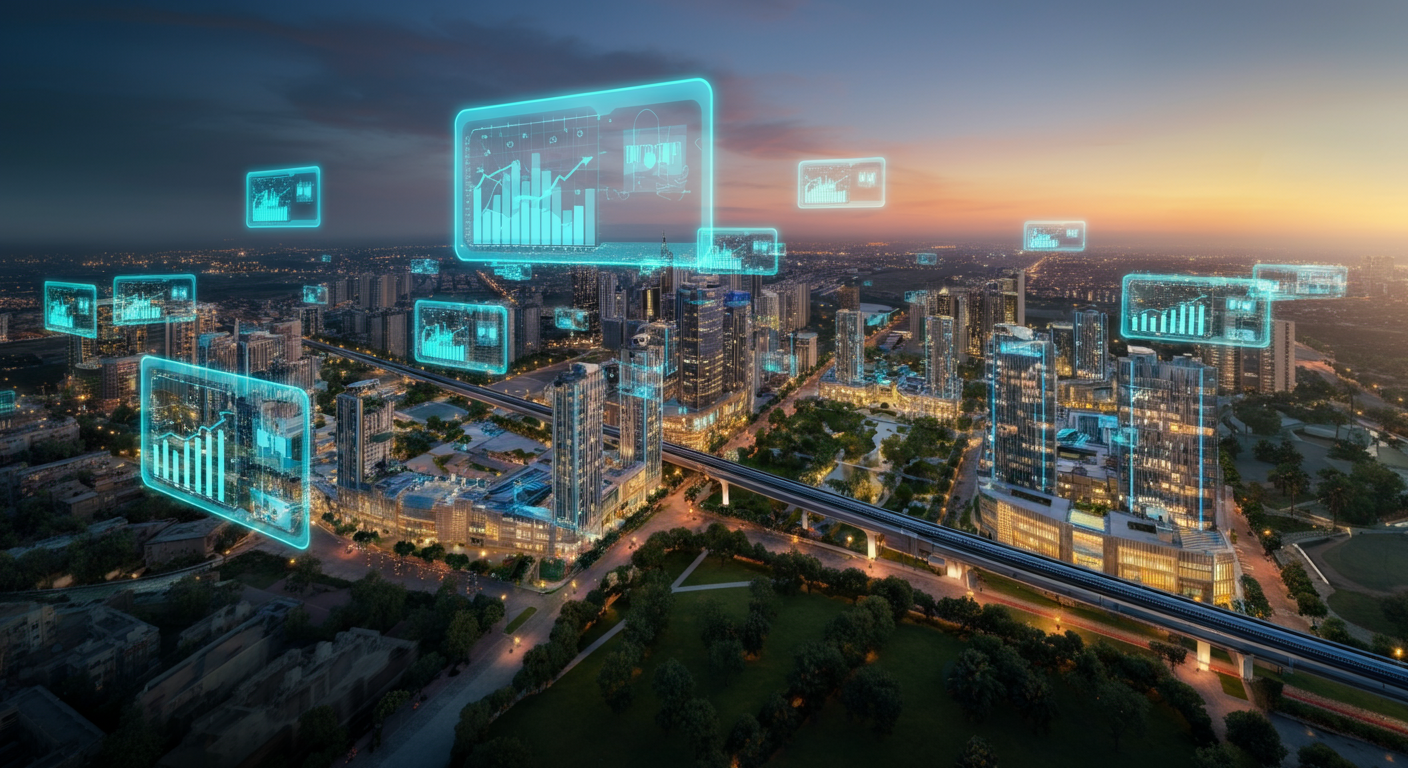
Digital twin technology is very useful in handling large mixed-use projects that involve not only residential, commercial, but also entertainment spaces. With these, developers are able to model not only the patterns of circulation but also connectivity between spaces. Infrastructure projects, such as smart city development, are also handled by using digital twin technology, which provides a platform for urban resource management.
Technology Enabling Digital Twins
The strength of digital twin technology is that it allows users to leverage advanced modeling, simulation, and integration techniques. Digital twin technology is different from 3D visualization tools in that it allows users to create a virtual replica of a physical space, which is not only visually realistic but also functionally realistic. Builders in Gujarat use different technologies for creating digital twins, but all these technologies play a crucial role in making sure that they are accurate, interactive, and functional.
3D Modeling Software
However, the most crucial part of a digital twin is a precise 3D representation of a building. Software tools like Revit, SketchUp, and 3ds Max help architects, engineers, and designers develop precise 3D representations of buildings. Revit is a powerful Building Information Modeling (BIM) solution. Using Revit, architects, engineers, and designers can add metadata along with precise 3D representations. Revit is a powerful solution for complex residential skyscrapers, commercial hubs, and mixed-use buildings in Ahmedabad and Vadodara. SketchUp is a powerful solution for architects, engineers, and designers. SketchUp is a powerful solution for architects, engineers, and designers. It can be used by developers for creating precise 3D representations of buildings. 3ds Max is a powerful solution for architects, engineers, and designers. 3ds Max is a powerful solution for architects, engineers, and designers. It can be used by developers for creating precise 3D representations of buildings. By using a combination of tools like Revit, SketchUp, and 3ds Max, developers can create precise 3D representations of buildings.
Real-Time Engines
Once the 3D modeling of the structure is complete, the real-time engine will then take the design and turn it into an immersive experience. This means that the stakeholders will have the ability to move about the virtual world and interact with the design. The stakeholders will also have the ability to test the design in various ways, such as the presence of sunlight and shadows.
For example, a developer in Surat, India, working on designing a high-rise apartment complex will have the ability to use the real-time engine and simulate how the sunlight will pass through the apartments during the day, or how the common rooms, such as the gym, will look once they are furnished. This will allow the developer to make the digital twin of the structure interactive, so that the investors and buyers will have a chance to experience the property virtually.
IoT Integration
However, digital twins can only function to the maximum potential if used in conjunction with Internet of Things (IoT) technology. The sensors used in a construction site or a working structure can be used to transmit data to the digital twin. This can be used to monitor the construction site, the structure, and the building in real-time.
Temperature sensors, humidity sensors, and vibration sensors can be used to transmit data to a digital twin, which can be used to monitor a construction site in real-time. This can be used to detect any deviations from the construction plan, ensuring the structural integrity of the construction site. In a working structure, IoT technology can be used to monitor the structure and ensure sustainability.
VR/AR Hardware
The virtual reality and augmented reality technologies provide the stakeholders with the ability to interact with the digital twin in an immersive manner. The Oculus Rift, HTC Vive, and AR-enabled tablets or smartphones allow the developers, purchasers, and investors to view the space in a full-scale manner, where they can walk through the space virtually to assess the space plans and designs.
- The immersive experience provided by the VR technology allows the stakeholders to walk into the virtual space, where they can assess the space in a realistic manner.
- The AR technology allows the developers to view the newly constructed space in relation to the existing surroundings, while the purchasers can view the completed space in relation to their surroundings.
The immersive technology provided by the virtual and augmented reality technologies makes the digital twin an effective communication tool, where there is no scope for confusion, and all the stakeholders can make informed decisions.
Cloud-Based Collaboration
Finally, cloud collaboration tools ensure that the digital twin can be viewed, edited, and shared in real-time. This enables several teams, including architects, engineers, project managers, and marketing staff, to work together simultaneously on the digital twin model.
This is particularly relevant in Gujarat, as developers may be working on several properties and may have several stakeholders involved. Cloud integration ensures all stakeholders have access to the latest information and prevents any delay in projects due to stale information.
Integrating Technologies for Maximum Impact
By using 3D modeling, real-time technology, IoT, VR/AR, and cloud-based collaboration tools, digital twins become not only intelligent but also dynamic. Digital twins are no longer just a computer model of a building; they also allow developers to simulate real-life situations. Hence, digital twins become not only beautiful but also functional. By using these technologies in Gujarat's highly competitive environment, developers gain a competitive advantage in terms of efficiency, minimizing risk, and maximizing the value of their projects. It may be a high-rise residential complex in Ahmedabad or a mixed-use commercial complex in Surat; digital twins become not only virtual but also functional.
Challenges and Considerations.
Although digital twins have numerous benefits, the following are some factors that must be considered by the construction industry before adopting digital twins:
Initial Investment: The creation of high-quality digital twins requires significant investment in software, hardware, and human resources.
Data Management: It is necessary to have correct and up-to-date information to ensure that the digital twin is a correct representation of the actual construction project.
Technical Expertise: There is a requirement to train staff on the creation as well as use of digital twins, which can be done by hiring specialized staff or partnerships.
Integration with Existing Systems: The digital twin has to be integrated with the existing project management, BIM, and monitoring systems of the construction project.
Future Outlook for Gujarat’s Builders
The use of digital twins is on the verge of becoming an industry norm in the real estate and construction industry of Gujarat. With an ever-increasing rate of urbanization, there is a need for quality and well-managed projects. Those who use digital twins will have a significant advantage in the following areas:
- Projects will be completed efficiently and on time
- Investors and buyers will be engaged through transparency and immersion
- Operational efficiency and sustainability will be optimized
- There will be a reduction of risks, mistakes, and construction costs
- New trends that can be used along with digital twins are expected to be introduced, such as AI simulation, predictive analytics, and smart city platforms.
Those who use these technologies in Gujarat will not only be able to provide quality projects, but also have a significant advantage in the market.
Transforming Real Estate Development
Digital twin technology is no longer a concept of the future but a reality that can bring a revolutionary change in the way builders in Gujarat think about the development of real estate projects. Digital twin technology can bring a revolutionary change in the way builders think about the development of real estate projects, and this can bring a lasting change in the construction industry in the state.
Digital twin technology can bring a revolutionary change in the way builders think about the development of residential apartments, commercial centers, and other types of projects. The builders who use digital twin technology are not only bringing a change in the way they think about the development of projects but also in the way they think about the future of smart and sustainable construction.
As the state of Gujarat continues to witness rapid development and urbanization, digital twin technology is going to play a pivotal role in shaping the future of construction excellence and turning concepts into interactive and intelligent realities.