How 3D Visualization Is Helping Real Estate Developers in Gujarat
Gujarat has proved to be one of the most promising markets for the real estate industry in India. Ahmedabad, Surat, Vadodara, and Rajkot are some of the cities that are witnessing ambitious projects in terms of high-end residential properties and commercial projects. In this competitive market, real estate developers are facing numerous challenges that include how to convince investors, how to communicate their design intentions, how to reduce errors, and how to market their projects effectively.
The conventional method of communication of projects, such as 2D drawings and floor plans, and static images, does not provide a clear idea to the stakeholders about how the spaces would look and feel once the project is constructed. This is where 3D visualization has brought a revolution in the industry.
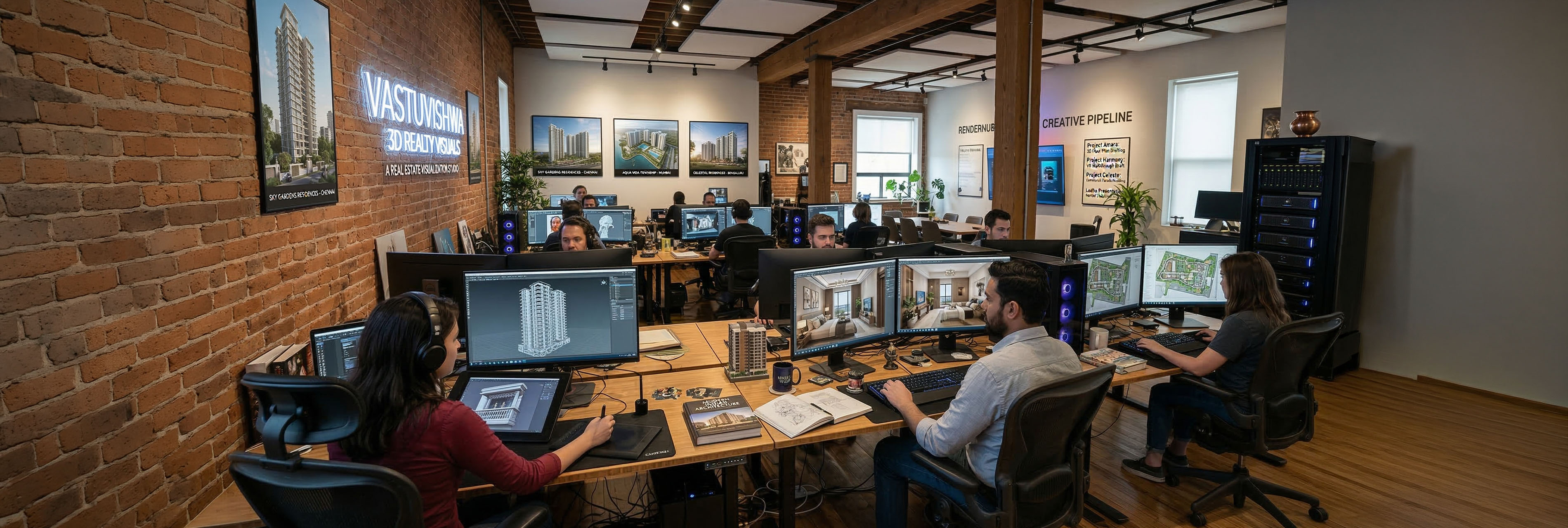
3D Visualization: This is the method of creating highly detailed and realistic digital models of real estate projects. This method allows stakeholders to experience a property before it is constructed. 3D visualization has proved to be a very important tool for developers in Gujarat, and this includes everything from realistic images to virtual walkthroughs, interactive floor plans, and even augmented or virtual reality experiences.
Bringing Designs to Life: From Concept to Virtual Experience
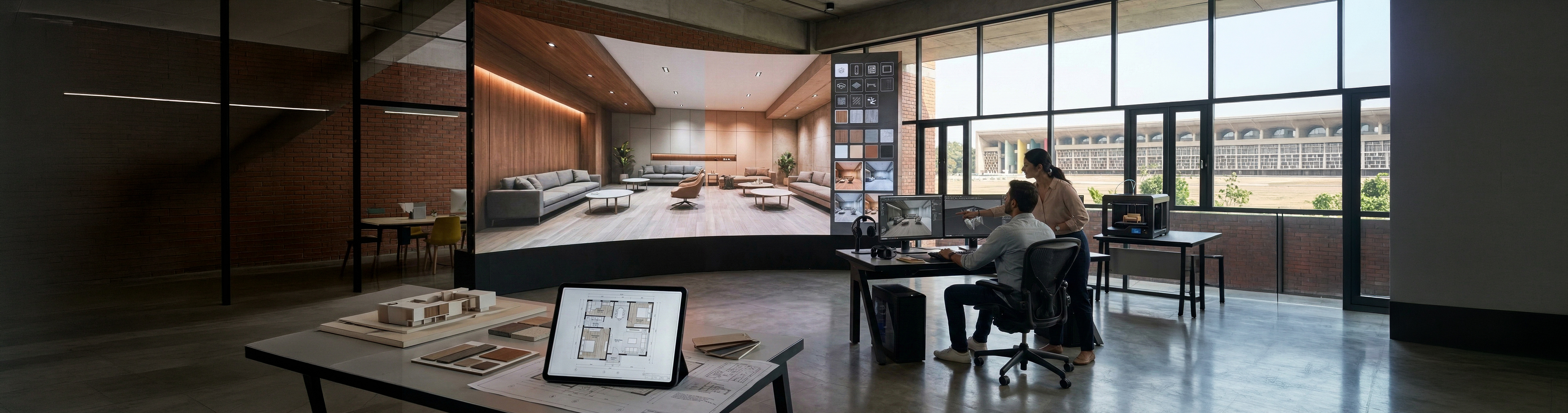
One of the greatest advantages of 3D visualization is the ability to put the design into life even before the first brick is laid. This allows the client/investor to see exactly what the materials, textures, and lighting will look like in the final product. The interactive walk-throughs take this one step further, allowing the user to not just walk through the interior but also walk the corridors and even the exterior spaces.
This has revolutionized the way developers in Gujarat are now able to market their properties and assess their value. For instance, high-end residential complexes in Ahmedabad can now be presented with the interior and exterior visualization, allowing the buyer to understand exactly what he is getting. Similarly, developers of commercial spaces can also benefit from this, allowing office spaces, retail spaces, and business parks to be virtually explored by the tenant/investor without the need for them to visit the construction site.
Another advanced version of 3D visualization is digital twin modeling, which is also increasingly being used. This technique allows the developer to create an exact replica of the building or complex, wherein all parts of the building can be manipulated and the lighting conditions can be simulated for any time of the day. The immersive experience allows for an absence of guesswork and instills confidence.
Accelerating Approvals and Streamlining Communication
One of the most time-consuming parts of real estate development is often getting the necessary approvals. The government, investors, and clients need to evaluate the feasibility, design, and layout of the real estate project. 3D visualization can help in this area since it is extremely accurate.
The virtual image will help the government evaluate the zoning, building, and safety aspects of the real estate project in a visually presentable way. The investors will be able to evaluate the quality, quantity, and consistency of materials used in a quick and efficient way, which will help expedite the process. The developers will no longer need to rely on technical images, which may be misinterpreted and lack context.
Moreover, 3D visualization can help in improving the communication between the real estate project development team. The architects, designers, project managers, and marketing departments will be able to use the 3D image, which will help ensure that all members of the project development team are "on the same page."
Marketing and Sales: Creating Immersive Engagement
Apart from the planning and approval process, 3D visualization has transformed the marketing process in the real estate industry in Gujarat. High-resolution images, animated walkthroughs, and virtual tours provide a rich experience that cannot be achieved through conventional images. Potential buyers can walk through a property virtually, experiencing the layout, interior design, and external amenities as if they were inside the property.
Interactive visualizations are most useful in off-plan sales, where properties are sold before they are completed. Potential buyers can customize interior design, furniture arrangement, and layouts virtually, giving them a sense of ownership even before they step into the property. This not only enhances engagement but also improves conversion rates for developers.
Digital marketing campaigns also gain. Virtual tours, 3D walk-throughs, and animated renders can be integrated into websites, social media sites, and real estate portals, increasing the scope of a project and attracting the interest of the audience. In a competitive market like Gujarat, there are a number of builders who are vying for the audience's attention. Immersive visualizations can give a project a competitive advantage.
Enhancing Decision-Making and Reducing Risk
Every real estate venture requires making intricate decisions, such as layout planning, interior planning, selection of materials, and landscaping. 3D visualization helps developers or designers assess numerous alternatives in a virtual setting before making actual construction commitments.
For example, a real estate developer in Surat, who deals in residential properties, can use 3D visualization to assess numerous alternatives, such as floor planning, finish options for facades, or landscaping, in a virtual setting. Conflicts that might arise in construction can be avoided, making 3D visualization a tool for minimizing risks, ensuring quality, and making processes easier.
Technology Behind 3D Visualization
The effectiveness of 3D visualization can only be achieved through the use of advanced technology. Real-time engines, such as Unreal Engine and Unity, can help developers create immersive and interactive environments that can have changes implemented in real time. Other modeling tools, such as 3ds Max, Blender, Revit, and SketchUp, can ensure precision in terms of dimensions, textures, and materials.
Virtual reality tools, such as Oculus and HTC Vive, can allow stakeholders to walk through a property, while augmented reality tools can allow digital versions of a space to be overlaid on a physical space. Web-based tools can also allow developers to create interactive versions of a space, allowing investors, clients, and teams to access them on their desktops and mobile devices.
The developers can benefit from the use of these tools in terms of faster decision-making, improved communication, and increased marketing opportunities, while avoiding costly mistakes.
Applications Across Real Estate Segments
3D visualization is an indispensable tool for real estate developers in Gujarat, given its versatility and flexibility in terms of project types. Be it residential, commercial, mixed-use, or luxury real estate, 3D visualization helps developers communicate their ideas in ways that traditional methods fail to deliver. With 3D visualization, developers can present their ideas in an immersive, accurate, and interactive way.
Residential Projects
In the residential segment, developers are increasingly using 3D visualization to show and present apartments, villas, or even entire residential complexes to prospective buyers. This is particularly significant in the growing Gujarat residential market in cities such as Ahmedabad and Surat, where competition between developers is high and buyers make decisions even before the construction is completed.
Interactive walkthroughs help prospective buyers explore the interior spaces of the residential units and walk through common spaces such as lobbies, gardens, and even clubhouse areas. This helps them virtually explore the spaces and get a better sense of how they might use the spaces and even how the lighting and furniture might work in the spaces. In addition to helping buyers make better decisions, 3D residential visualization is also a tool for developers to present and highlight the various amenities available in the residential complexes, such as parks, swimming pools, gymnasiums, and even playgrounds.
Another significant advantage of 3D residential visualization is the ability to customize and personalize the spaces and make the buyer more engaged with the spaces even before the construction is completed.
Commercial Properties
For business establishments such as offices, retail malls, and business centers, 3D visualization is useful for understanding the usability and efficiency of the area. For offices, for instance, one can explore the office area to get an understanding of how it is organized for circulation, collaborative spaces, and private offices.
In the highly competitive Gujarat real estate market for commercial properties, being able to virtually present properties to potential tenants is a major advantage. One can assess whether a given premise is suitable for their needs without having to visit multiple locations physically. Investors are also able to have confidence in the design and feasibility of a project, thus making it easier to invest in such properties.
Mixed-Use Developments
Mixed use projects, which involve large-scale construction with residential, retail, office spaces, and recreational areas, require a special kind of challenge to be met. In mixed use projects, the most important factor is understanding how spaces connect and how spaces relate to one another. 3D visualization helps developers create a whole model where the entire complex can be virtually walked through.
This helps developers demonstrate how spaces relate to one another and how spaces connect with each other in terms of foot traffic and how amenities connect with residential and office spaces. This not only helps developers with investor relations but also helps architects and planners work more effectively with developers and project managers.
Luxury and High-End Projects
In other words, when it comes to luxury properties such as apartments, villas, or gated communities, the level of involvement is higher. Buyers of such properties are not only looking for quality construction, but also want to develop an emotional bond with the property. In such cases, 3D visualization can be of significant importance, as it can help communicate the level of luxury and exclusiveness associated with a particular property.
High-end visualizations can be used to showcase the luxurious features of a property, along with special architectural features and interior design. With 3D visualization, buyers can virtually walk through every room of the property and enjoy the natural light changes throughout the day, along with other amenities such as landscapes and outdoor space. This can be a highly effective and engaging tool.
By utilizing 3D visualization services in these sectors, developers based in Gujarat can improve their project understanding, identify the right investors or buyers, and make all aspects of the development process smoother, right from the beginning till the end. The technology helps make abstract ideas concrete, so that all aspects, both practical and aesthetic, are understood and appreciated by all parties involved.
Emerging Trends in Gujarat's Real Estate Visualization
As technology advances, several emerging trends are likely to define the future of 3D visualization in Gujarat:
- Integration of BIM and 3D Rendering: The integration of Building Information Modeling (BIM) and 3D rendering helps developers manage design, construction, and operations more effectively.
- Interactive Customization: Interactive customization helps buyers personalize the design and layout of the house and increases buyer satisfaction.
- AI-Enhanced Visualization: AI is being used to automatically make adjustments to renderings, create various design options, and even simulate natural lighting.
- Sustainability Visualization: Developers can use 3D visualization to demonstrate how eco-friendly a building is to investors and authorities.
Measuring ROI from 3D Visualization
Today, developers in Gujarat are realizing that 3D visualization is no longer just an essential part of their design process; it is an investment with clear returns. This is because 3D visualization enables stakeholders to experience a project virtually before it is built, thus helping them avoid costly mistakes during the construction phase. There is also faster approval from regulatory authorities and investors, which is a direct result of 3D visualization. This is because regulatory authorities and investors can quickly approve a project without any hiccups, thus helping it get to the construction phase without any delays that are common due to miscommunication or lack of clear understanding of what is to be built.
In marketing and sales, there is a clear advantage to 3D visualization. This is because 3D visualization engages potential buyers more than any other form of marketing or sales approach. This is especially true for developers who rely on selling off-plan properties.
In addition to this, the ability to test design options virtually ensures that developers can optimize layouts, finishes, and spaces without incurring additional construction costs. This provides investors with transparency into the design and quality of a project, which can speed up funding decisions and reduce risks. Overall, when all of these factors are considered, 3D visualization is a tool that not only improves the quality of a project but can improve the bottom line of a developer as well, and therefore serves as a key ROI driver.
Real-World Impact in Gujarat
In Gujarat, cities such as Ahmedabad, Surat, Vadodara, and Rajkot are witnessing real changes in how projects are planned, presented, and sold with 3D visualization. For example, luxury residential projects in Ahmedabad are using 3D walkthroughs to enable potential buyers to experience their apartments, villas, etc., months before construction even commences. This allows developers to pre-sell their projects, thus providing cash flow security for their projects.
Commercial developers are also reaping significant benefits. Office spaces, retail, and commercial projects are using highly detailed 3D models to enable investors to remotely experience their projects. This has proven to be highly advantageous in cities such as Gujarat, where new business centers are emerging. Time is often a constraint in such cities, but 3D visualization has proven to be a major boon for these cities.
Even government or municipal projects have started using 3D visualization for urban planning, infrastructure development, and proposal presentations. By using 3D visualization, it is easier for the government and citizens to understand the proposed layouts and other factors of a project. This will help the government and citizens make better decisions and avoid any confusion about a project.
The use of 3D visualization is creating a profound and lasting impact on the real estate industry of Gujarat, as it is helping real estate projects achieve better results in design, approvals, marketing, and trust with investors. By using 3D visualization, real estate projects can plan and execute better, and it is easier to present a project.
Transforming Gujarat's Real Estate Landscape
3D visualization is more than just a design aid; it is revolutionizing the way real estate projects are designed, presented, and perceived in Gujarat. The real estate developers do not have to depend solely on drawings, brochures, and their own imagination to showcase their projects to the stakeholders. Instead, all the stakeholders can visualize, experience, and evaluate the project in a realistic, interactive, and immersive environment.
With the integration of technology, creativity, and user experience, 3D visualization has emerged as the foundation of real estate development in the modern era. It has the ability to increase efficiency, enhance the effectiveness of decision-making, maximize the marketing impact, and ensure the success of real estate projects in Gujarat.
In the competitive and dynamic real estate industry of Gujarat, the real estate developers who employ 3D visualization are not only increasing the efficiency of their operations but also setting a new benchmark for transparency, engagement, and innovation. The future of real estate development in Gujarat is increasingly 'digital,' 'immersive,' and 'interactive,' with 3D visualization at the core.